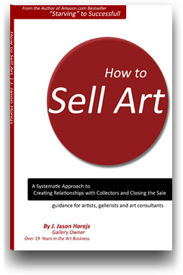
| A Systematic Approach to Creating Relationships with Collectors and Closing the Sale |
a New Book by J. Jason Horejs | Owner Xanadu Gallery | Scottsdale, AZ |
 Wouldn’t
it be great if art sold itself? If you have tried to sell art, you
know it doesn’t. Selling art takes effort and skill. Wouldn’t
it be great if art sold itself? If you have tried to sell art, you
know it doesn’t. Selling art takes effort and skill.
Jason Horejs has been in the gallery business for over 18 years and has
owned Xanadu Gallery in Scottsdale, AZ since 2001.In his new book, How to Sell Art,
Horejs shares the entire selling process he and his staff employ when
making a sale. From introductions, to creating a compelling dialogue,
to closing a sale and beyond. Horejs gives you concrete,
step-by step instructions that will help you
tap and develop your inner salesperson.
As with any other skill, you can increase your sales success by taking
a systematic and consistent approach. How to Sell Art will help you take your art salesmanship to a higher level.
As an artist, you will have many opportunities to sell your art,
whether it's directly to a customer at a studio tour or weekend art
show, or through a gallery at an opening. Order How to Sell Art today
and become an expert at building relationships with potential
buyers and closing the sale.
|
|
|
| |
In How to Sell Art you
will learn:
1.
How to start off on the right foot. The first sixty seconds can make
all the
difference when you are interacting with a buyer. Make sure you are
giving the right first impression.
2.
How to learn
your client’s names. No more excuses – it’s time to become a master of
names. Learn techniques that will help even the most artistic
of minds capture a name like a steel trap.
3.
How to offer the client an opportunity to buy. If you aren’t giving the
client
a chance, they are never going to buy. Make sure you are saying the
right thing at the right moment to close the sale.
4.
How to negotiate like an expert. Selling art is not like selling used
cars,
but there will, inevitably, be times when you need to negotiate with a
client. Negotiation is a delicate process. Learn how to
expertly navigate a negotiation and make sure that both you and your
client come out winners.
5.
How to follow up
persistently without being irritating. If you aren’t able to close some
sales on the spot,
that’s OK – you can still secure a sale by consistently and
persistently following up.Some clients need a little time to get to a
point where they
are ready to buy, but if you don’t follow up they are likely to simply
forget about you and your work.
6.
Create
Fans. The sale isn’t the end of the sales process, it is only the
beginning. Turn buyers into collectors with post-sale follow up and
systematic communication.
And much more . . .
If you are a
painter, sculptor, fine-art photographer, jeweler, gallery salesperson
or art promoter you will benefit from How to Sell Art
|
|
| |
| Learn
to sell your art like a professional |
| How to Sell Art |
| J.
Jason Horejs |
|

|
Owner,
Xanadu Gallery, Scottsdale, Arizona |
18
Years Gallery Experience |
| Author of Best-Selling book "Starving" to
Successful |
Multi-Million
$ in Art Sales |
|
Available Now
Order Today
Retail Price Retail Price: $24.95
$19.50 + s&h
(Special offer - Limited Time Only)

Paperback, 207 pages
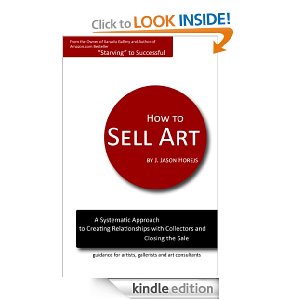
Kindle Version Available at Amazon.com
|
| |
 |
 |
| |
| Order
together with Jason Horejs' best-selling first book "Starving" to Successful and
save $15.40, plus get free shipping on both books. |
| |
Order How to
Sell Art + "Starving" to Successful
$49.90
$34.50
Free Shipping & Handling!
|
|
| |
|
| |
Recommendations From Readers of "How to Sell Art" |
| |
Hello Jason,
I thought I would provide you with some positive feedback regarding your book, HOW TO SELL ART.
First of all, the book arrived just as we were starting a 3 day outdoor art show. So I got to read the book.
I had to read it quickly so that I could use the ideas in a real live environment as soon as possble.
So on the second day of the show, I became enthused with your suggestions. I reached out vocally to
people who came to the tent. I worked at getting to know them and what they were looking for.
And, I think that I did a pretty good job using some of your ideas and they worked.
We were able to sell a few pieces (originals) that day.
Also, during the show we asked people who appeared really interested but wanted to check size of walls etc.
to give us their email address. The Monday following the close of the show, I sent out emails (at least 6) with thumbnail
images of the pieces and details and pricing information to those individuals that had indicated an interest.
I received 2 responses back and one of them is asking to buy an original.
So, I just want to say thank you for the timely information. Your ideas work!
Regards,
Rosemary Naemsch, for Michael Naemsch (ARTIST) |
| |
I loved, loved, your book, how to sell my art!
I did great at my last two open studios: 10 sales for sure + 12 commissions and many more people to visit or who will come and visit me, this coming week...
Thanks for everything you do.
Florence
Artist,
Video at http://vimeo.com/12300191
Website at http://www.florencedebretagne.com
|
| |
Hi Jason
Yesterday, I got your email about your new book on "How To Sell Art". I
read your sample chapter 5 and knew instantly that your book was full of
valuable insights on selling art. I ordered your book immediately. The
following day I had an open studio tour at my house and I thought I would
try some of your sales techniques that you talked about in chapter 5. I
started to engage the potential customer in conversation about my
photographs. This is something that I haven't done too much of in the past.
I told the story behind the photograph that they seemed to be attracted to.
I started asking questions about what they liked about my work. This is all
lead to a closer bond to that potential customer. At the end of the day I
sold 3 large piece and I am so thrilled that I thought I would say thanks.
I don't even have your book yet and I made 3 sales! I am looking forward to
tomorrow's open studio and trying more of what I learned in that one
chapter.
Thanks
Vincent DiLeo
www.vincentdileo.com |
| |
I thought you'd like to know that I
took a booth at the Architectural Digest Home Design Show and extended
my hand to every single person who stepped into my booth - and there
many - and introduced myself just as you suggested.
As the days went on (4) I kept thinking of your advice and how it
worked like a charm!
I sold 4 pieces to a gallery in CT, made other gallery connections with
an invitation to show in NYC, negotiated a more desirable contract with
one in Toronto and met tons of interior decorators and designers.
I've never experienced anything quite like this. I can't thank you
enough for sharing your knowledge with us!
Cecile Brunswick
Artist, NYC |
| |
I
used your suggestion last night and invited two interested buyers
to an opening at Maple
&
Main Gallery in Chester, CT, to
buy my paintings. They did! I
sold two
pieces last night!
Joan
Cole
Artist, CT |
| |
I dived into your book, "How to Sell Art", last night. Love how you detail every part of the artist or gallerist/collector interaction, from the moment the collector walks in the gallery or studio door to when they walk out either with a purchase or not. How many times have I wondered what my approach should be at each juncture- you've choreographed it so well. I smile and recognize so many of the various perplexing situations you describe - and you offer solutions.
You get us out of the filmy world of artistic creation, into the concrete on-the-ground reality of organizing our production and connecting real people with the art on the wall.
Sincerely,
Karen Horne
Artist, Salt Lake City
|
| |
For me, the most critical part of the book was the section where you wrote about talking about one's work. It has utterly transformed the ease with which I am now writing about my work.
I have word doc with descriptions of my pieces so that they're handy when needed. Now, when I open that document, the first thing I see are your six points on what to touch on when speaking about a piece. I am usually completing two pieces at a time because I always have a few in play so the first thing I do is read over your words, enter the names of the new pieces and then jot down what first comes to mind after having read your ticklers.
Because each piece is different, different aspects of each work come to mind when 'thinking' about them. I then refer back to your ticklers to see where I might need to expand. Usually, once I've got the 'story' started, one thing leads right to the next and the tales unfold all by themselves. I keep the work in front of me as I write and it's amazing to discover things I hadn't even realized were there!
Proceeding in this way keeps the format of the entries very different from one to the other so it doesn't look as if I've followed a formula at all. In addition, I find that writing about each piece allows me to speak about the work, when that is necessary, with greater passion and detail.
Thank you so much!
Victoria Pendragon
|
|
|
|
|